A Paralympic champion with spina bifida is one step closer to capturing the U.S. Senate seat that was once held by a key architect of the Americans with Disabilities Act.
The post Closely Watched Senate Race Features Candidate With Spina Bifida appeared first on Disability Scoop.
The nation's top health official is pursuing access to most Americans' medical records to research a link between vaccines and autism — a connection the medical establishment studied and flatly rejects.
The post RFK Jr. Seeks To Peek At Americans’ Medical Records For Clues On Autism And Vaccines appeared first on Disability Scoop.
New article from Special Needs Jungle:
Just because the consultation is over, it does not mean we can just sit back and wait to find out what Government AI will make of whatever your submitted. The …
The post Don’t stop making noise: Sign to save SEND Legal Rights! Here’s 3 easy actions for this half term appeared first on Special Needs Jungle.
Special Needs Jungle
ⓒ Special Needs Jungle 2008-2025 All Rights reserved
One state's $1 billion school voucher program prompted requests from thousands of families who sought to show their children had disabilities qualifying them for additional funding for private school.
The post Vouchers Fuel Surge In Special Ed Evaluations, Straining Public Schools appeared first on Disability Scoop.
New article from Special Needs Jungle:
If you sat in on our Schools White Paper webinar with Department for Education Minister, Georgia Gould, last month, you’ll have heard plenty of concerns from parents about accountability in …
The post The Government thinks Ofsted will ensure SEND reform accountability. This evidence suggests ‘significant concern’. appeared first on Special Needs Jungle.
Matt Keer
ⓒ Special Needs Jungle 2008-2025 All Rights reserved
The Trump administration is unveiling long-awaited details about new, more stringent Medicaid eligibility rules and raising fresh concerns about implications for people with disabilities.
The post Medicaid Changes Will Push People With Disabilities Off Program, Advocates Warn appeared first on Disability Scoop.
The U.S. Department of Housing and Urban Development is sharply limiting which types of animals people with disabilities who are renting a home can claim as a "reasonable accommodation."
The post What Counts As An ‘Assistance Animal’ Just Got Narrower appeared first on Disability Scoop.
A national program uses tennis to help children and teenagers on the spectrum develop and benefit from social connections and fitness.
The post Tennis Players Open Their Courts — And Hearts — Through ACEing Autism appeared first on Disability Scoop.
Social Security is proposing a rule change that may affect hundreds of thousands of people on Supplemental Security Income who live with family or friends.
The post Proposed Change Could Cut SSI For Nearly 400,000 Beneficiaries appeared first on Disability Scoop.
New article from Special Needs Jungle:
By Megan Cutts, Mairi Jeffery, Kathryn Mills-Webb One of the main thrusts of Bridget Philippson's argument about getting more children into mainstream is for their wellbeing and belonging; to be …
The post Research shows children in special schools report higher self-esteem than those with SEN in mainstream appeared first on Special Needs Jungle.
Tania Tirraoro
ⓒ Special Needs Jungle 2008-2025 All Rights reserved
For the first time in more than two decades, federal officials are moving forward with plans to find out just how much schools across the nation are spending on students with disabilities.
The post How Much Do Schools Spend On Special Education? Feds Aim To Find Out appeared first on Disability Scoop.
Navigating your child’s educational journey can be challenging, especially when you notice they are struggling in ways that do not...Read more
The post Understanding Common Learning Differences: A Guide for Parents first appeared on Smart Kids.
The sisterhood in our house is built on differences
lkinross
Thu, 05/28/2026 - 10:11
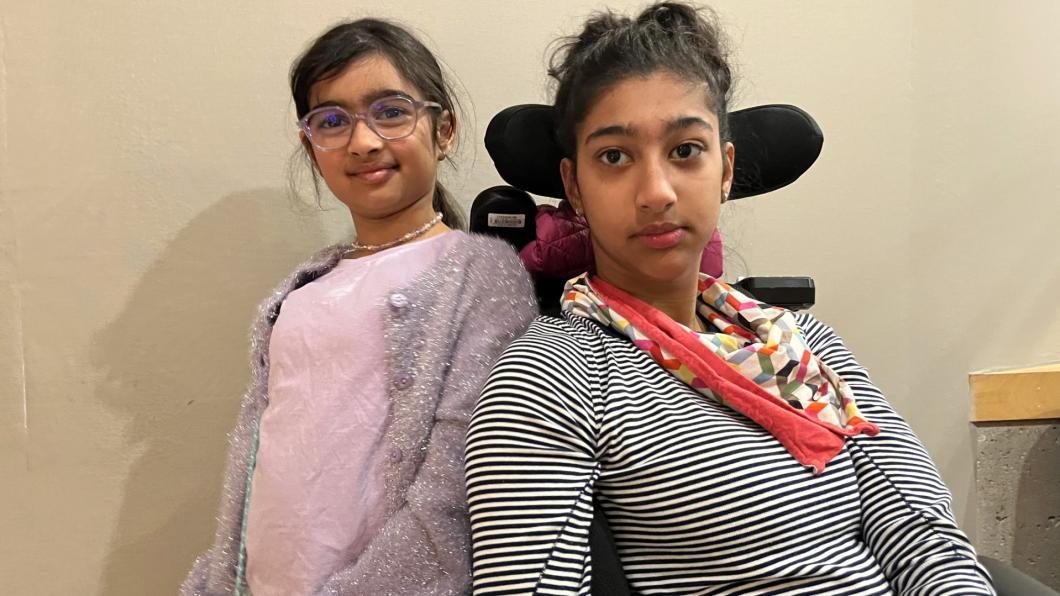
May 28, 2026
Nal, 8 (left), and Syona, 15
By Anchel Krishna
When I was pregnant with our second child, my daughter Syona was thrilled. There are seven years between the girls, and a full house was something we always wanted. It just took us a bit longer to get there, as we needed to adapt to Syona's cerebral palsy.
Syona loved to rub and kiss my growing belly, calling the baby “Booniya,” a name she made up that we used throughout the pregnancy. We did not know Booniya’s biological sex, so the whole thing was a game of surprise for us. Syona, though, was clear about what she wanted. She only wanted a sister and announced more than once that she would send the baby back if it turned out to be a boy.
Nal, a girl, arrived with some drama, as most babies do. Once we were all settled at home, watching Syona with her little sister became one of my greatest joys. She helped hold the bottle at feeds. She loved washing the baby bottles. And as Nal grew into a busy, mobile baby, I noticed she would seek Syona out in crowded spaces when she felt overwhelmed, like her big sister was a safe place to land.
If you had asked me then what sisterhood would look like in our home, I might have imagined matching outfits, whispered conversations and endless games, all adapted to meet Syona’s needs.
But like everything else in parenting, I have learned that what I imagine and what happens are often worlds apart.
My daughters are so different: in age, personality, interests and ability.
Syona loves loud music. The louder, the better. Nal prefers things quieter and often asks us to turn off the music or turn on a podcast.
Nal loves screens. Syona refuses to watch TV or movies. Nal wants to play with her sister constantly, while Syona often wants space. Nal hugs freely and with voracious affection, multiple times a day. Syona is more reserved and not especially interested in hugs.
In our house, sisterhood often means balancing competing priorities, while my husband Dilip and I quietly hope both girls do not have high-needs moments at the same time. There are also stretches of real conflict: for example, an early morning rally of shouts, yells and cries, all with a deadline of getting out the door.
One of the biggest things we try to do is make space for both girls to be fully themselves. When you parent a child with a disability, it is easy for the whole house to revolve around appointments, accessibility and accommodations. But we work hard to make sure Nal’s interests and needs matter just as much.
That means one-on-one time with each girl. Sometimes Nal and I plant flowers together or go on a trail hike. Sometimes Dilip takes Syona to the mall or the library, where she often makes new friends along the way. I never want Nal’s identity to become “the sibling of a disabled child.” She deserves room to figure out who she is. Even so, Nal is aware that she is the only kid in her circle with a sister whose disability looks like Syona’s.
Our goal as a family is to build a sense of belonging, leave room for each person to be themselves, and acknowledge that sometimes things are harder for us and we all need to flex around that. So how do we foster closeness between two kids who are so different? It comes down to encouraging shared and separate interests in roughly equal measure and letting the girls see what Dilip and I love too. Here are a few things that work for us:
- Treat them as a team. We try to do this in concrete ways. Pairing them up when we play a family game. Finding chores they can do together instead of separately. Talking up shared interests, like baking, which they both love helping with, or a good Thai meal, which they will happily eat their way through together. Even encouraging them to team up on Dilip and me to lobby for their favourite takeout.
- Stop jumping in. We let them answer each other’s questions and finish their own conversations, even when it would be faster to step in.
- Teach explicitly. We talk to Syona about what being an older sister means. We talk to Nal about Syona’s disability. And we connect both pieces back to what it looks like in their actual relationship.
- Make space for everyone. That means protecting each girl’s separate interests as carefully as the ones they share and letting Dilip and I have our own things in the mix too. In the car, that shows up as a blend of music and podcasts for the girls, with a smattering of '90s hits and hip hop to keep Dilip and me going. The girls roll their eyes. We keep playing it anyway. I want them to grow up knowing that the adults in their life are full people too, and that making room for everyone is what family looks like.
There are harder conversations too. Recently Syona told me that sometimes she feels left out because she is the only person in our family with a disability. Hearing that hurt, because we work so hard to build a home that feels inclusive and accepting. But it reminded me that disability can feel isolating, even inside a loving family. There are experiences she carries that the rest of us do not fully understand. So we sat with it, and we talked about it as a family.
I have also been thinking about how closeness does not grow from being alike. When I look at the family I was born into and the friends who have become family along the way, it is not our similarities that make us close. It is the act of doing life together, the ups and downs, which builds the bond.
Do we get it right all the time? Absolutely not. But we try, fail, reflect and check in before we keep going. My hope is that someday, down the line, the girls realize we were building something strong on the very foundation of their differences.
How do you build sibling relationships in your family? Comment below or shoot a message to BLOOM Editor Louise Kinross at lkinross@hollandbloorview.ca. We may share your ideas in future.Like this content? Sign up for our monthly BLOOM e-letter or take our short BLOOM survey.
Music helps hospitalized children find the tone of their emotions
lkinross
Wed, 05/27/2026 - 11:53
May 27, 2026
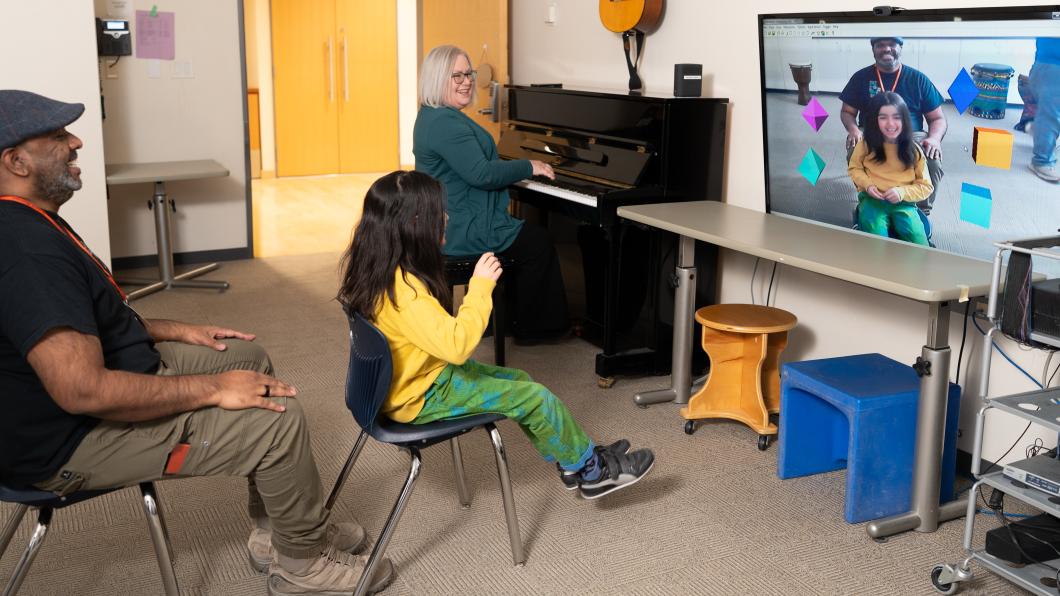
Carol Olympus, training to be a music psychotherapist, sits behind Jasper, who plays a virtual instrument. On piano is Holland Bloorview music therapist Andrea Lamont.
By Louise Kinross
For Carol Olympus, music has always been key.
As a teen in India, he played drums and guitar in bands. He also helped set up a non-profit that gave youth opportunities to stage concerts and street theatre. Later, he worked as an audio engineer and ran a concert management business in Dubai, handling live sound for artists such as Quincy Jones, Bryan Adams and the Eagles.
Today he’s a master’s student at Wilfrid Laurier University on a placement at Holland Bloorview. It’s part of his training to become a music psychotherapist. Olympus sports a purple baseball cap that matches the fringe on his beard, which his daughter dyed for him.
Music allows Olympus to work with children who are hospitalized in a unique way. “Brain scans show that when people play music, it lights up every zone in our brain," Olympus says. "That opens many channels for connection and allows us to go deep with clients very quickly.
One of his first tasks is to quell any performance fear. “I’ll say ‘Let’s make sound and see what that feels like,’” Olympus says. “If you don’t think in terms of scales and Mozart, and you just sound it out, it can express how you feel in the moment. We have this saying: ‘Music sounds like our feelings feel.’”
In the hospital’s music therapy studio, children and teens can explore a wide range of instruments, including a marimba, piano, guitar, ukulele, drums, noisemakers, shakers and a virtual music instrument.
Sitting beside a child at the piano, Olympus says he can have a conversation using sound. “If two of us are at the piano, you can hear so much of what a child is trying to say in the way they play. And they can feel your support in what you play back to them. There’s a sort of back-and-forth between the two of us that helps them feel safe enough to keep going or explore some different sounds and then come back to what feels safe. The process unfolds like we are having a dialogue but without traditional language.”
While music therapy can help a child reach physical rehab goals, music psychotherapy focuses on mental health.
Olympus decided to make a career switch when he and his family moved to Ontario at the beginning of the pandemic.
To narrow his search, he drew three circles: in one he listed his abilities, in the second he identified his passions, and in the third he wrote down what he felt the world needs. “The words that stood out were music, psychology, and people.”
Olympus’ parents were social workers, but before moving to Ontario, he didn’t know that music therapy existed. “Psychotherapy is not a regulated profession in India, and there’s no college to report to. There’s a lot of stigma about mental health in South Asia.”
He learned about the master’s program at Laurier and the school was willing to take his music industry experience into account.
When asked what qualities are most important in his role, Olympus says: “Listening to what the client is saying, listening to what they’re not saying, and listening to what they can’t say without your help. Of course, empathy and compassion are a given.”
Olympus recalls one client who appeared to avoid playing one note on his instrument. “When we spoke about it, he told me that the note sounded like aggression and anger to him, and that’s why he avoided it. That led to a conversation about a traumatic incident he hadn’t addressed before, and it opened a floodgate of emotions that we then processed together.”
If Olympus could change one thing about how inpatients are supported, it would be ensuring their psychotherapy continues after discharge. “Discharge is based mainly on physical, not psychological, rehab,” he says. “Patients leave with a list of community therapists, but someone who has been deeply vulnerable with you may not want to start over with a new person. I’d like to create a bridge where there’s a way to hold their hands for as long as they need.”
In addition to working with patients one-on-one, Olympus works with groups that have a particular focus, like sensory needs or chronic pain.
He also does online music psychotherapy with parents of children with disabilities in a program called Harmony ONTrack. It’s a collaboration between Holland Bloorview and Laurier that offers free weekly, one-hour sessions.
“Each parent has a unique story,” Olympus says. “Many open up about their deepest fears, frustrations, and anger. I aim to create a safe space that they may not have in daily life. At work, they often feel they must put on [a brave face], and at home, they play the role of the mother. In therapy, we make room for the other parts of who they are and hold them as a whole person.”
Olympus selects music that matches a parent’s mood and has meaning in their culture.
Goals may include expressing emotion, identifying and changing unhelpful patterns, and “finding or reclaiming identity or reintegrating parts of yourself.”
Olympus was initially sceptical that this work could be done online, but “I’ve been pleasantly surprised at how effective it’s been.” The online format allows parents to do therapy when it fits their schedule.
Olympus says the greatest joy of his work is seeing his patients make progress. One child had short-term memory loss and issues with speech after an injury. Olympus used melodic intonation therapy that involved singing a tune in repetition, because music helps encode a memory better than speech alone.
“A few weeks into the process he saw me from afar in the lighted bridge and remembered my name. ‘Carol!’ he yelled. “I thought ‘Oh my God, you remember my name.’ I’ve always been a believer in psychotherapy work, but in the last year at Holland Bloorview I’ve seen how music takes it to a whole different level of connection.”
To manage his own stress, Olympus “plays drums or guitar as an outlet. I’m a voracious reader, I walk, and my kids keep roping me into all these silly things.”
As a student at the hospital, Olympus says he’s grateful to participate on an interdisciplinary team. “We all bring in our experiences and insights to work towards what’s best for the client. Having a voice at the table, even though I’m just a student, and being treated like one of the team, is something I don’t see very often in a large organization. I’ve come away with the deepest respect for everyone.”
Olympus hopes to work with underserved communities. For example, “the South Asian population I understand well in terms of the cultural aspects and stigma. They are woefully underserved in the mental health space locally. They either don’t know that our service exists, or stigma prevents them from availing themselves of it. I’m hoping to fill that gap.”
Last night he was jamming with HB Rocks, a hospital program that brings together local musicians, music therapists, volunteers, students and youth with disabilities to create a rock band.
“I’ve done this back home, but the key difference, thanks to Andrea Lamont’s genius, is that HB Rocks treats the children who perform just as musicians. It’s not people with disability getting an opportunity to play on stage. It’s just a bunch of musicians coming together and having fun in the community. One client wakes up at 6 a.m. on the day of the show and lays out her music sheets and prepares. Just like any other musician would.”
Like this content? Sign up for our monthly BLOOM e-letter or take our short BLOOM survey.
Children with ADHD and learning differences often work much harder than others realize just to get through the school day....Read more
The post Supporting Emotional Adjustment in Children with ADHD & Learning Differences first appeared on Smart Kids.
